


Historic Cumberland Caverns in Tennessee Protects the Natural Splendor of the Cave.
Hidden beneath the hills of Warren County, Tennessee, lies one of the state’s greatest geological treasures—Cumberland Caverns, a place where science, history, and wonder intertwine. Designated as a National Natural Landmark, Cumberland Caverns is one of only 13 National Natural Landmarks in Tennessee and one of just three caves to receive this honor, along with Craighead Caverns and Big Bone Cave. That distinction carries both privilege and responsibility. Every path, light, and tour inside Cumberland Caverns is designed around one central goal: to protect a living ecosystem while helping people experience it responsibly.
A Living System Beneath Our Feet
Unlike a museum exhibit or a monument, Cumberland Caverns isn’t static. It breathes, drips, and grows. Water continues to carve its way through limestone, formations slowly build crystal by crystal, and unseen organisms thrive in the dark. Preserving this balance means understanding that the cave itself is alive—a complex system connecting geology, hydrology, biology, and time. When visitors walk through its passageways, they aren’t just seeing rocks; they’re witnessing natural history still in motion.
Conservation Through Experience
At Cumberland Caverns, conservation isn’t about closing doors—it’s about opening eyes. The philosophy is simple: people protect what they experience. Through carefully guided tours, visitors of all ages can explore miles of underground chambers while learning about the forces that shape our planet. Those experiences turn curiosity into stewardship. For many, a first visit to Cumberland Caverns sparks a lifelong respect for nature—and for some, even a career in cave science. The balance between preservation and participation defines everything we do. Handrails, lighting, and pathways are positioned to minimize disturbance, and even the air circulation inside the cave is monitored to protect delicate microclimates.
A Window Into Tennessee’s Water
Caves are more than scenic destinations—they’re windows into the health of the land above. Water entering a cave tells a story about the surface world: what it carries, how it flows, and how clean it is. That’s why educating visitors about groundwater is central to our mission. Tennessee’s karst landscape—filled with sinkholes, springs, and hidden rivers—forms a vast, interconnected system. What happens above ground, from land use to pollution, directly affects the drinking water that flows below. By understanding this connection, guests leave not only entertained but also more aware of their role in protecting the environment that sustains them.
Guardians of a Fragile World
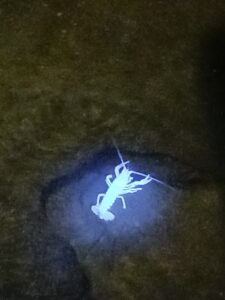 Cave crayfish, like the one pictured above, are obligate cave dwellers—they can’t survive anywhere else. These sensitive species glow under blacklight, an effect that reveals their remarkable adaptations to life underground.
The creatures that call Cumberland Caverns home remind us how interconnected and delicate this ecosystem truly is. Some species have evolved for life in complete darkness, developing pale or translucent skin and heightened senses. Our guides use these encounters to spark fascination, not fear. During Bat Week and other educational programs, guests learn that bats, salamanders, and even tiny cave insects play crucial roles in maintaining healthy ecosystems—both underground and above.
Partnerships That Protect
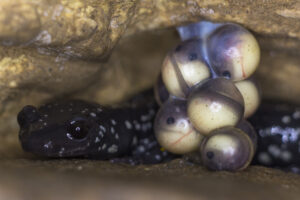 This salamander lays eggs on land and stays with her clutch even after hatching. Watching these life cycles unfold alongside partners like the Niemiller Bio Lab is one of the daily rewards of working underground.
Cumberland Caverns works closely with researchers, biologists, and universities to deepen our understanding of the cave’s ecosystem. Among those collaborators is the Niemiller Biological Laboratory at the University of Alabama–Huntsville, which studies cave-adapted organisms throughout the Southeast. Research like this helps us monitor species populations and environmental conditions, ensuring that the cave remains a safe, thriving habitat. It also strengthens our educational programming by bringing real science to life for visitors.
History That Lives On
Cumberland Caverns’ story isn’t just geological—it’s human. Early explorers like Roy Davis, Tank Gorin, and Lewis Cardwell mapped its vast chambers decades ago, driven by pure curiosity. Their passion for exploration laid the foundation for today’s operation, where science and safety guide every visitor’s experience. That history continues in the present. Our guides carry forward a tradition of discovery that began long before electric lights or handrails—teaching guests not only how the cave formed but why it matters.
Beyond the Surface: A Natural Classroom
Every tour through Cumberland Caverns is also a lesson in patience. Geological formations like stalactites and flowstone take thousands of years to form, reminding us how slowly nature works when left undisturbed. Educational programs connect these ideas to real-world topics—like water conservation, soil chemistry, and climate science—making the cave a natural classroom. School groups often leave understanding not just how caves form, but how every choice we make on the surface affects the world below.
Changing “Spooky” to “Spectacular”
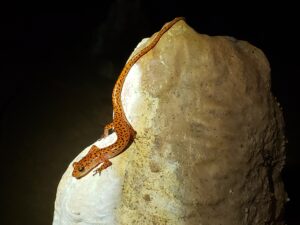 The brightly colored Cave Salamander (Eurycea lucifuga) is a common sight in Tennessee’s underground streams and one of the most photogenic ambassadors for cave life.
Caves have long been linked to mystery, especially around Halloween. Their darkness, silence, and hidden depths seem tailor-made for spooky stories. But at Cumberland Caverns, we use that same curiosity to replace fear with fascination. When visitors learn that bats help farmers by eating pests, or that salamanders indicate clean groundwater, the narrative shifts. What was once ‘creepy’ becomes incredible. Knowledge transforms perception—and that’s the heart of conservation education.
Respect, Not Restriction
Preserving the natural state of the cave doesn’t mean keeping people out—it means bringing them in carefully. Every aspect of our operation is designed to reduce impact, from the placement of lighting systems to the structure of guided tours. We follow best practices established by national organizations such as the National Cave and Karst Research Institute and the National Speleological Society (NSS), ensuring that each guest’s experience supports the larger goal of protecting this fragile resource. By managing tourism responsibly, Cumberland Caverns serves as both a sanctuary for nature and a stage for discovery—a rare place where conservation and curiosity coexist.
Why It Matters
As one of only three cave systems in Tennessee recognized as a National Natural Landmark, Cumberland Caverns represents something larger than itself: the enduring relationship between humans and the natural world. Our mission is to ensure that future generations can stand where ancient water carved these halls and feel the same awe. When they do, they won’t just see stone—they’ll see the heartbeat of Tennessee’s natural heritage.
Experience the Wonder. Protect the World.
Cumberland Caverns invites visitors to explore safely, learn deeply, and leave inspired. Each visit supports the ongoing preservation of one of the most remarkable underground environments in the nation. Because the more people understand about the hidden world beneath us, the more they’ll care about protecting it.